
Why do men (still) earn more than women? Why does Eveline find a job faster than Fatima? Why does Gerrit (61) always lose out to Thomas or Sanne (32). Or is Mădălina not offered her assessment in her native language? As DE&I policies begin to gain traction, these practices still hurt your eyes.
“Inclusion creates a welcoming environment where differences are not approached defensively but respectfully, opportunity-wise and learning-wise.”
Diversity, where does it stand?
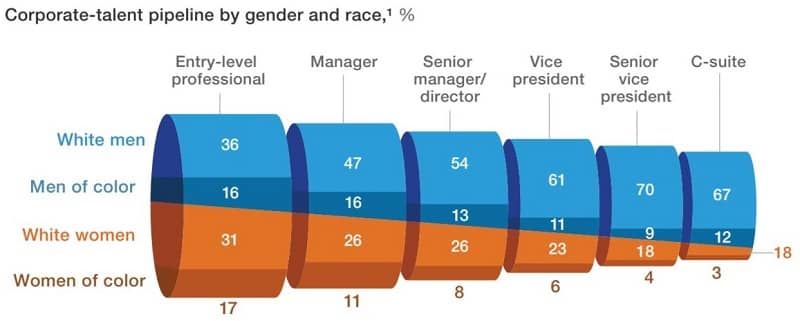
In 2018, McKinsey published a global study on diversity in “the pipeline.” In the picture, you can see how diversity is distributed across the layers of the surveyed organizations (the listed organizations in the G20). And what we already know is expressed here in numbers: the higher up in the organization, the less diverse it becomes. And yes, according to this study, this also applies to Europe.
“D, E and I stand for Diversity, Equity and Inclusion. These concepts are stackable. D&E are the foundation under Inclusion.”
What does Diversity mean?
DE&I stands for Diversity, Equity and Inclusion; translated: Diversity, Equity and Inclusion. They are 3 different terms, which cannot be used arbitrarily interchangeably:
Diversity
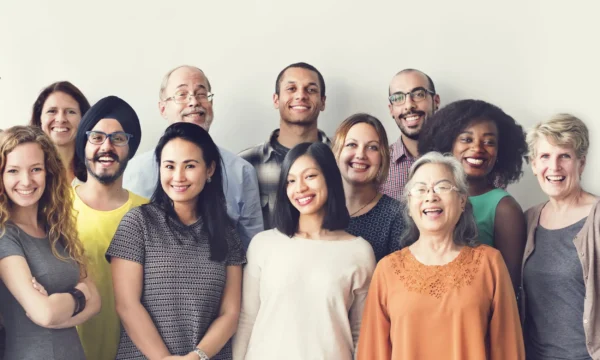
deals with all conceivable ways in which (groups of) people differ from each other. For example, racial, ethnic, gender, disability, gender, religion, knowledge, and cognitive diversity, and combinations in between. And not only from observable differences but especially from perceived differences.
Justice
has, above all, to do with progress, future prospects, opportunities, and access to networks and information for all people. Within organizations, this means that rules, systems, and processes must be just and fair, and leaders must be permanently alert to equality for all.
Inclusion
creates a welcoming environment where everyone feels welcome and where differences are not approached defensively but respectfully as opportunities for growth and learning.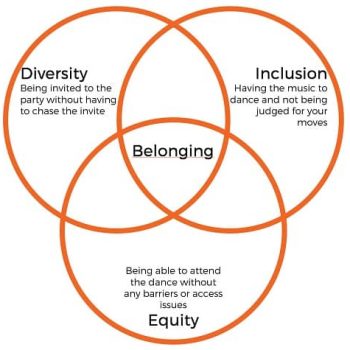
Source: Sonya Barlow
Concept by Vernã Myers
“DE&I leads to a culture change. So why start it?”
Diversity, Equity and Inclusion reinforce each other.
So diversity, equity, and inclusion are not the same thing. They reinforce each other. A lot of diversity in your organization does not mean that everyone feels at home and gets equal opportunities to develop. A diverse organization is not necessarily inclusive, whereas an inclusive organization is usually fine with diversity.
Diversity is generally easier to start with, though. Just by (visually) scanning an organization, you can identify and monitor ethnic, racial, and/or gender diversity. In fact, diversity is step 1, and equity is step 2 to achieving an inclusive organization.
In an inclusive organization, where everyone feels happy, rules, systems, and processes are tested for fairness and equality (Equity). Such a test is very confronting. For assume that current systems and processes are not equitable.
Testing for equity requires leadership and a change-minded approach. If you want your organization to grow into an inclusive one, accept cultural change.
“Organizations with a lot of diversity need to build a collective memory.”
Diversity and Inclusion, why get involved?
Culture change: brrrrr. So why pursue an inclusive organization anyway? There are 2 reasons for that: one good reason and one very good reason:
Reason 1: diversity is socially desirable
Let me just start with the good reason. This reason is extrinsically driven, though, and therefore, for an organization, not as strong as reason 2. As society increasingly embraces DE&I as the “norm,” you don’t want to be left behind. Sure, the fewer people excluded, the more people get future prospects, that’s nice. And at the macro and meso level, that’s a no-brainer. But for the hiring manager who has to choose between Gerrit and Sanne, it’s not yet a done deal. The closer it gets to us, the bolder we have to be and the more we have to unlearn old habits. Or the other way around: behavior change becomes easier if it is in our own best interest. And that makes implementing DE&I from a socially desirable standpoint alone a very tough mission.
Reason 2: it’s good for business
A very good reason, it ensures support, anchoring, and is intrinsically driven. DE&I is demonstrably good for your organization’s performance. Search for business case inclusion, and many articles will appear on your screen, including clear analyses and positive links between diversity and business performance. Many positively mentioned effects of inclusion are:
- is a driver of innovation, essential to compete;
- improves empathy toward clients and the labor market;
- expand the talent pool to attract new talent;
- is good for organizational culture, in terms of dynamism and focus;
- makes employees feel good.
“Storytelling, one of the most universal human experiences, gives us a rare chance to look through new lenses.” – from Havard Business Review
DE&I requires patience and conviction
An inclusive organization must grow. I am referring especially to “growing toward each other.” An organization with a large diversity of people needs to build a collective memory. That means understanding each other, listening to each other’s stories, creating awareness, naming obstacles, and getting in tune with each other. To build a collective memory, you need time and respect. In addition, leaders must have already begun to dismantle systems of discrimination and subordination.
Leaders must persevere in this process. But then you also build an organization that is sustainably connected to society, encourages innovation from every conceivable angle, moves with more pace than its competitors, can surprise customers every time, and generates better profits than before.