
The Corona crises produce much discomfort, many concerns as well. But it also offers new insights and opportunities. Less traffic (the NS reports 85% fewer travelers), less activity and cleaner air, for example. Also opportunities for recruitment and selection. In this blog I will give you two concrete opportunities that can be realized quickly.
The Corona crisis as a vacuum
The Corona crises will be a temporary one, see also Professor Arnoud Boot in Buitenhof (from 1:50 min). That means we are now in a kind of vacuum. And we can take actions that will allow us to ride the wave of economic growth in the future (it is impossible to predict when). I have listed 2 opportunities that can ensure a better influx of talent and innovation in the recruitment and selection process.
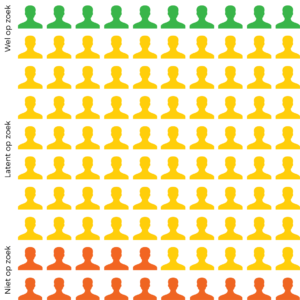
“During summer vacations, over 1/3 of latent seekers reflect on their current job and desired career.”
1. Opportunity for recruitment: building relationships with latent seekers
In the field of recruitment and selection, there are opportunities here. In the coming weeks, many professionals (fix and flex) are glued to their home office. By working from home, many professionals step out of the daily hectic, creating more space for evaluation, self-reflection and developing other thoughts about work, for example. Issues that were not prioritized a week ago (due to all the hectic activity) can now, in the coming days and weeks, be seriously considered.
For recruiters, now is the time to present relevant propositions to latent seekers.
2. Opportunity for selection: alternatives to the job interview
Currently, people try to avoid f2f contact as much as possible. Moreover, people work at home, happen to have a cold, are abroad and cannot return, etc. Job interviews are therefore difficult to organize. What alternatives are there? I will mention a few:
The online pre-assessment: a short online test that measures an essential trait and generates a learning experience for the applicant. Delivers a clear pass/fail decision. Inexpensive, clear and reduces the number of f2f interviews.
The online assessment: provides more and broader information about intellect, personality, and motivations. And related behavioral competencies. A perfect preparation for an (online) interview. Without personal contact, you receive information that an interview will never provide. Usually cheaper than the interview itself.
Video: making calls with video. Numerous platforms are available for this, such as Zoom, Hangouts, Skype or Cisco’s Webex. During the video call, the results of an online assessment, for example, can be discussed.

And after that? Well f2f contact? Sure. Collaboration remains people work. But at the end of the procedure. By then you will have avoided personal contact with all the dropouts. And you can give all your attention to the talent you want to hire.
It has long been known that unstructured interviews in particular hardly provide reliable information on the basis of which you could predict functioning. Now that f2f contacts are less popular, it’s a good time to try something else!
“The interview process is basically a cycle in which you gather as much evidence as possible whether someone will be able to be successful. That goes beyond an impression.”
Opportunities for recruitment and selection – in conclusion
Are you having a quieter time than usual? Go crazy, do things differently. Innovate and launch small pilots to improve recruitment and selection. And especially if you want to recruit talented medior and senior professionals, now is the time to take action.
Do you have any questions?
If you would like to know more, please feel free to contact us.