
Yep, a blog about integrity. Or the lack thereof. Complex subject. Very big topic, too. With many victims, much damage, and many pitfalls. But also a lot of profit for those who get away with it or handle it well. We asked ourselves: Can the profession of assessment psychology contribute to this subject in a positive way? We think so.
Yep, a blog about integrity. Complex and vast subject. With many victims, many damages. But also many gains, for those who get away with it, or handle it well. We wondered: can our profession contribute to integrity in a positive way? We think so.
Integrity damage can be caused by anyone
The newspapers were full of it: corporate espionage and the theft of IP by criminals. They enter the workforce (permanent or flex) to enrich themselves through fraudulent activity. That is their agenda. To keep this group out, consider background checks and screening. Scientifically, links between microexpressions and lying have been demonstrated. AI and expert applications are also available in this area. But these solutions are by no means certain. To be clear: even a psychological assessment does not offer certainty here.
But it is not just the criminals who create integrity risks.
Even people like you and me can cause damage to integrity under certain circumstances. Often, minor damages (such as being improperly sick) occur, but if they occur frequently, they still result in significant damage. Sometimes, large-scale damages, such as the well-known diesel scandal, the Tibor interest, money laundering, data scandals, etc. Extensive activities where several employees were involved in an organized manner.
Integrity damage can be caused by anyone in any organization. But there is good news: solutions exist to reduce integrity damage. That’s what this blog is about.
What is integrity?
In the vernacular, integrity is often seen as a character trait. Integrity used to be called that. This implies that integrity is more or less a given: you either have integrity, or you don’t. However, this is too limited. Even from an HR perspective, there is not much you can do with this.
Integrity can be approached from 2 angles:
From a compliance perspective, integrity is seen as a risk an organization faces from within, stemming from its employees’ behavior. You’re talking about the internal standards of behavior and agreements that an organization imposes on itself to reduce the risks, which we’ve seen often in recent years.
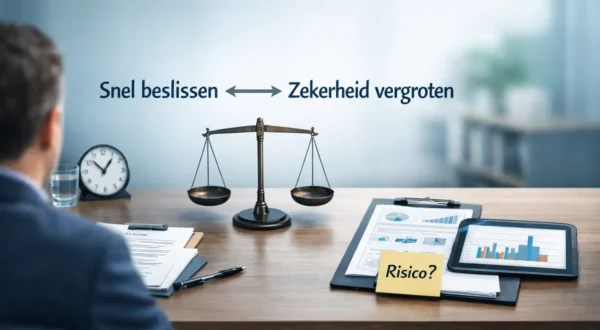
From the individual’s perspective, behaving with integrity always involves a balancing of interests. For example, a short-term vs. long-term consideration or a personal interest vs. an organizational interest. Integrity or non-integrity behavior emerges when people face dilemmas in balancing interests. Moreover, over time, dilemmas may become greater, for example, as circumstances change or the individual changes.
Assessing integrity
Integrity is a loaded topic. If you judge an employee as lacking integrity, it has a big impact on motivation. Therefore, it is important to keep the assessment as close to the situation as possible.
So not, “we don’t think you have integrity,” but, “in this particular situation you showed ……. behavior, however, what we would have liked to see according to our integrity compass is ……. behavior.
Not easy, but doable. You do need to be able to refer back to very specific examples. Systematic observation and recording of behavior are prerequisites for assessment. If you don’t do that, and therefore can’t refer back to specific situations, then you are judging by character, and your employee will quickly perceive that as character assassination.
In short: assessing integrity is about behavior, not character.
Predicting integrity
Functioning can be predicted. That’s our business. But can you also predict integrity? In our profession, prediction is about risk assessment: the probability of a given behavior under specific circumstances. So the question is: what causes risks of unethical behavior? I list about 5 risks and how you can estimate those risks:
1. Views and attitudes
These have been tested using classical integrity tests. The question is directly about integrity. We call this overt or overt testing. It first asks how a candidate feels about certain integrity issues. Then the question is asked to what extent the candidate himself has been involved, and acted, in the various integrity issues. This form of testing is not widely used in the Netherlands. In the US, however, it is common. These tests are then used as a pre-screening tool, especially for high-volume executive positions.
2. Personality
In personality questionnaires, the assumption is that certain traits are associated with an increased likelihood of integrity risks. Thus, this does not ask openly and directly about integrity but predicts based on certain traits. For example, low conscientiousness and high risk appetite are associated with increased integrity risk.
3. Motivation
At Starcheck, we map 18 drives. This allows us to know what motivates and drives a candidate, what they strive for, and what they need in the job. It provides insight into the match between a candidate’s needs and the organizational culture or context. More match is more intrinsic motivation. Less match is less intrinsic motivation. Little match leads to demotivation. Demotivation increases integrity risks.
Example 1: A candidate has a strong need for security, unity, cooperation, fairness, and the absence of stress. The organizational culture is strongly focused on results and output. Employees are judged on individual performance and encouraged to outperform colleagues. Match? Not really! Chances are the candidate’s intrinsic motivation decreases and integrity risks increase (e.g., improper absenteeism).
4. Hardened
Another aspect we can identify is counterproductive behavior. After all, if the match between people and organization is limited, do things go wrong right away? It doesn’t. To that end, we measure 6 psychometric characteristics of a candidate’s resistance to frustration. A low frustration tolerance increases the likelihood of counterproductive behavior. A high frustration tolerance and a more hardened candidate reduce the likelihood of counterproductive behavior.
There is no point in giving a candidate a stamp of integrity or lack of integrity. It makes sense to outline the extent to which the candidate aligns with the organizational culture. And how sensitive a candidate is to the lack of that match. Both in terms of motivation and the kind of risky or counterproductive behavior he will then exhibit.
Example 2: The candidate from Example 1 is hired anyway, and after a while, becomes less motivated. He/she starts exhibiting counterproductive behavior. The security this candidate needs is not felt, and he does not feel he is treated fairly enough. Has the feeling that he does a lot for his colleagues, only for them to take the credit. From the assessment, we have information on two main areas: impulse control and ethical awareness. The assessment indicates that ethical consciousness is most affected by a decrease in motivation. This candidate begins to respond less openly and honestly, becomes less transparent (because he quickly feels others are using him), and is less likely to keep appointments.
5. Organizational culture
With integrity, the work environment is also a major influence. If the organization itself struggles with values and norms, for example, by rewarding non-integrity behavior anyway, when it does produce results. Or the organization allows large differences to exist between the explicit and implicit organizational culture. Values, norms, rules, and culture must fit together and even reinforce each other. If there is ambiguity about this, you can no longer call anyone to account for non-integrated behavior. And it becomes predictable that sooner or later integrity damage will occur.
So, integrity risks can be reduced?
Yep. On the one hand, you can assess integer behavior (learning and correction moment). On the other hand, you can predict the risks of non-integrated behavior. By doing that structurally, the risks and associated damages decrease.
And it may sound boring, but as an organization, consistency is especially important. The culture must stand! Not in pretty one-liners at the reception or in the annual report. But in do’s and don’ts. People don’t do what their bosses say. People do what their bosses do.
Resumee
- Between employer and employee, integrity is about behavior, not character. Non-integrity behavior should be discussed at the behavioral level and situation-specific.
- Drives indicate whether there is a match between person, work, and organization in terms of drive. That match directly influences motivation. Motivation affects integrity risk.
- In the event of a mismatch, it is possible to predict what type of counterproductive behavior a candidate will exhibit. Risks can thus be identified.
- Organizations in which values, norms, rules and culture reinforce each other have fewer integrity risks.