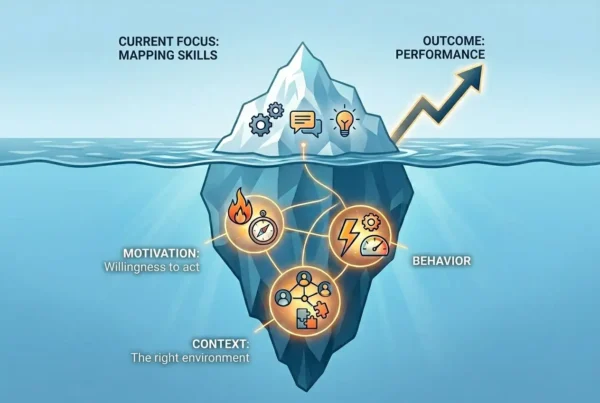

In a time of labor market scarcity, the candidate experience is of great importance, right? All barriers a candidate encounters on his/her journey should be removed, right? Or do we strike out? And does the quality you hire decrease? If you fear that, there is good news: Quality selection and candidate experience go hand in hand! In this blog, I go into more detail about the dilemmas and concrete solutions.
To improve the candidate experience, selection barriers are lowered or eliminated. As a result, the quality of your hires decreases. However, quality selection and candidate experience go hand in hand! Read more about the dilemmas and concrete solutions.
Candidate experience as a threshold breaker
Because of scarcity, we have become addicted to the candidate experience. Under the guise of candidate experience, we make it as easy as possible for candidates to get hired. We make ourselves look prettier on FB, we use cool-sounding language, and we instruct interviewers to be especially friendly and sell the position and organization well.
Recognizable? Then I’ll add to it: then we let poorly pre-selected candidates interview with hiring managers who need to be nice (and don’t actually have the sense and time to do so). And then when you hire those candidates, you motivate the real top performers in your organization to leave. And those can go anywhere.
“A candidate experience as a threshold breaker is only candidate-friendly and leads to increased turnover.”
Candidate experience improves conversion. What conversion?
The job market is exploding, and we don’t really want to turn anyone away. We saw this same picture in 2006 and 2007. Every candidate not hired was a missed opportunity. C’est l’histoire, qui se répète. And therein lies the rub: the pool is empty, conversions in recruitment must increase, and all those selection filters: they could be a little less.
With a candidate-friendly approach, conversions do indeed go up in the short term. Percentage-wise, more candidates move on to the “hiring phase.” Well-done!
But whether other conversions improve in the long term is the question. Does performance benefit? Top performers perform at least 50% better than average. Absenteeism sometimes? Turnover rates? Customer satisfaction? Competitive strength? Executive strength? In 2007-2008, these numbers came under pressure at many organizations. The recession only amplified that effect. Will history repeat itself again?

Candidate experience without the disadvantages
Is that possible? Yes, a good candidate experience can be combined with a thorough selection. I am not going to list exhaustive possibilities here. But I will share three experiences:
The learning experience
First of all, we experienced firsthand that a positive candidate experience does not mean avoiding sharp selection. During 2018H2, we asked thousands of candidates to complete an online assessment to identify which talents matched a career in ICT. So under a random audience. And without insight into their CV. It took our website by storm with very high desired conversions and the absolute top talents in the final round. How did we do that? And it’s so obvious: relevance. Our candidate experience was highly relevant. Relevant proposition and especially relevant feedback after each round. So that candidates got to know themselves better. And became curious about the next round. So our candidate experience became not a nice trip, but a learning experience!

The cost-me-no-time experience
In addition to providing a learning experience, you can make the selection filters approachable. I’ll give you a few tips from our practice:
- If you want to test online candidates, collect only data that matters. First determine for yourself what you definitely do and possibly do not need to know. This way, a candidate will experience this round of testing as short and relevant.
- Use stepped assessment programs. These are programs that do not require a candidate to take all the tests and questionnaires at once; they can be completed at different times. The 1st stage is short and filters on a core quality. For candidates who score above the norm, stage 2 may be longer, but it is also definitely more relevant and educational. With a stepped assessment, you spend limited time and receive a learning experience. Give and take is balanced. Candidates who score above the norm do not drop out because of a selection filter, as such a filter provides a relevant and learning experience.
- Use adaptive tests and questionnaires. With these, test-taking takes up to 50% less time compared to traditional tests and questionnaires.

The fun experience
Finally, you can also focus on making selection filters really fun. And yes, that’s when the word gaming comes up. In 2019, gaming has several (sharp) edges. What good is a game, which the CEO thinks is incredibly cool, and the target audience …ehh … boring. Or a game of which you don’t know exactly what it measures? The bar is high! A script-picture-question game for finding out a broad construct like entrepreneurship really can’t be done anymore. The useful tips I can give you are:
- Use recruitment games exclusively to promote your organization. The game makes the candidate select your organization, not the other way around.
- Assessment games can be used to assess a specific skill or psychological construct. Such a game has a limited scenario and is built on a clear knowledge domain or psychological construct.
- In general, games resonate better with young audiences below bachelor’s level. Fun is just a little more relevant there than a learning experience.
- Read our blog on the differences between recruitment and assessment games

In summary: candidate experience and good selection.
- If you want to merge a good candidate experience with good selection, offering a cool learning experience yields good results.
- If you deploy test and questionnaires, keep it short, relevant and use adaptive technology.
- A stepped assessment program delivers, at each stage, a good balance between the time invested and the learning experience received.
- Gaming and gamification can produce good results, but factor in significant investments of time and money.