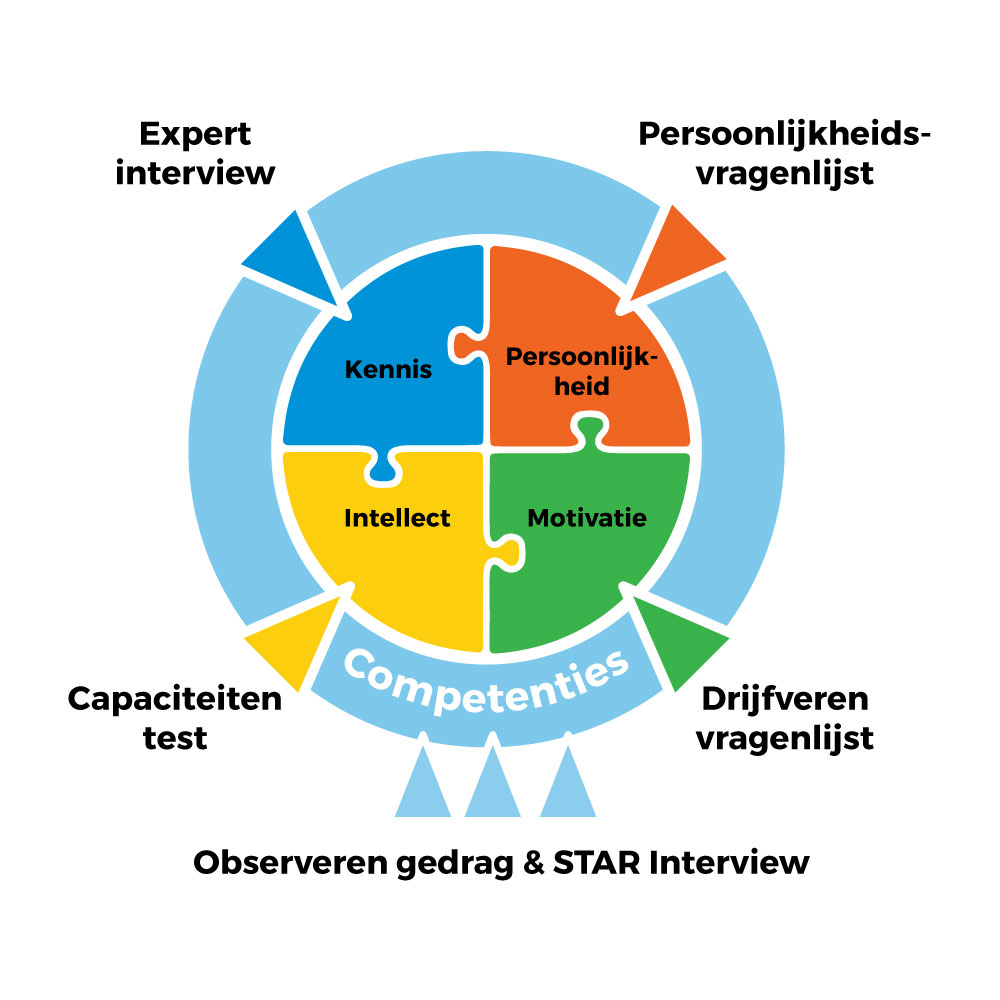
A psychological assessment maps aspects of intelligence, personality, drives, experiences, and behavior with tests, questionnaires, interviews, games, role plays, and assignments.
This allows a psychological assessment to predict a person’s performance, indicate desired development, and identify detrimental risks.
By identifying risks, a psychological assessment provides important information for making a recruitment or career decision.
With a psychological assessment, you avoid making the wrong talent decisions. The costs of a wrong hire quickly amount to ½ to 1 year’s salary.
First, we can observe behavior. This can be done with assessment exercises and with structured selection interviews. Serious games can also provide meaningful insights into behavior. To standardize observations in language and meaning, competencies are often used. Many organizations already use competency sets and are familiar with them. A competency is a successful observable behavior with a fixed definition (meaning). Behavioral observation and interviews are used to assess the mastery level of competencies.
To go one layer deeper than observable behavior and assess the developmental potential of competencies, we need to examine psychological traits (attributes). These are in the areas of intelligence, personality, and drives.
Broadly speaking, there are 4 reasons to use a psychological assessment:
A psychological assessment is a quick way to gain in-depth insight into a candidate. It provides insight into competencies in terms of social, professional, or leadership skills. But also deeper aspects such as: analytical potential, personality structure, motivation, and frustration tolerance.
This allows you to make an educated guess about whether the candidate will succeed in the intended role, either directly or through growth.
In the event of a change in position, promotion, transfer to another business unit, or organizational change, you have limited information about how the employee will function in that new context. An assessment helps to assess opportunities and risks. For HR, this means thorough insight into the employee’s chances of success and development needs in that new work context. A conscious risk assessment and development plan can be made.
In cases of career questions, outplacement, reintegration, or when an employee no longer functions optimally in the current role, an assessment focuses on the person’s qualities and motivations, and which work context fits best. Here, the focus is less on immediate suitability and more on potential and appropriate development so that the right career choices can be made.
You can improve lead qualification by employing online pre- or self-assessments. This provides inquisitive applicants with meaningful insights about themselves and their relationship to your organization. This strategic use of assessments enhances the quality of your talent pool and improves candidate engagement by providing a learning experience that provides insight into themselves.

An assessment is not a substitute for performance evaluations in the work context. It provides valuable predictive insights, but actual functioning should be recorded with a performance assessment. Also, if a record needs to be built, it will need to be done with performance assessment, not assessment data.
Of course, it is interesting to compare retrospective assessment data with assessment data. With these comparisons, connections can be made between psychometric attributes and performance. These insights can then be used in upcoming recruitment campaigns.
This fact sheet provides an overview of the most commonly used (psychological) selection methods, both classical and modern. The figures are based on meta-analyses and dominant scientific literature.
| Method | Predictive validity (r) | Typical reliability |
|---|---|---|
| Cognitive ability (GMA test) | .51 | High (.85-.95) |
| Work test | .54 | High (inter-rater ≥.70) |
| Structured interview | .51 | Medium-high (.60-.75) |
| Unstructured interview | .18-.38 | Low-medium (.40-.55) |
| Integrity test | .41 | High (α ≥.80) |
| Conscientiousness (Big Five) | .31 | Medium-high (α ~.75-.85) |
| Job knowledge test | .48 | High (≥.80) |
| Years of service | .18 | Not applicable |
| Video/asynchronous interview (incl. AI) | .30-.40 | Good at structuring; algorithmically variable |
| Machine learning / algorithmic models | .20-.50 | Depends on dataset; generalizability limited |
| Serious games / game-based work samples | .35-.50 | High on objective metrics |
| Social media screening | .00-.20 | Low and variable |
Call directly:
+31 88 277 377 6