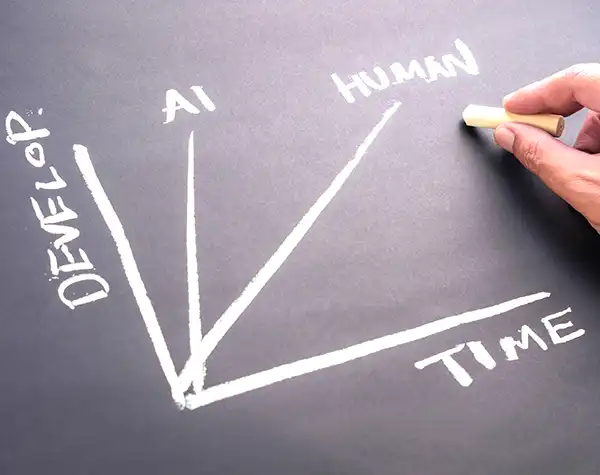
An aging population and stagnant labor force growth are contributing to a tight labor market. Artificial intelligence (AI) helps alleviate this issue by increasing productivity and taking over routine work. However, AI also brings about a new challenge: the tight labor market has shifted from a quantitative issue (too few workers) to a qualitative issue (a lack of workers with the necessary skills). Human Resources (HR) leaders must not only focus on retaining key positions and attracting new talent but also address the growing skills gap and the need to develop both digital and human skills.
Where others advise from trends or technology, we look at the human factor: behavior, culture, and collaboration. And how these factors contribute to growth and acceleration.
From our expertise, we offer predictive insights for individuals, teams and organizations. In doing so, we advise HR leaders not only what to do, but also how it works in practice.
Skills will be the primary HR trend in 2025-2026, but the term can often be too broad. In HR, a skill refers to a demonstrable ability within a specific context (i.e., what someone is capable of doing) at a defined level.
Take Cybersecurity. According to the World Economic Forum, this is one of the fastest-growing skills. However, the meaning differs by role: for non-IT people, it is mainly about secure behavior (phishing, data use, reporting), whereas a Security Engineer needs a whole skills matrix. Therefore, you need to peel off skills: from label to concrete behavior and measurable criteria per target group.
Starcheck is an expert in this. We translate skills into clear definitions and reliable measurements. Because cyber risks often stem from human behavior, we developed a unique personality questionnaire for non-IT workers that shows how behavior affects cybersecurity skills.
We measure what is currently present in your organization in terms of skills, motivation, and potential. We do this through validated psychological assessments, additional research, and data models.
Together, we map out which skills and behavioral competencies are needed for your strategic goals. For example, for innovation, growth, or cultural change.
Then, together, we design the programs needed to bridge gaps: from development paths and leadership development to skills-based recruitment and internal mobility.
We provide measurable KPIs and dashboards for skills, behavior, and performance. This approach makes HR data-driven and strategically measurable.
Targeted talent acquisition: we advise on establishing a sustainable talent acquisition strategy, including employer branding and skills-based recruitment.
Retention and retention: we help develop strategies to reduce turnover, increase internal mobility, and secure key positions.
Development and growth: we translate assessment data into learning and development paths to help employees realize their potential and keep organizations agile.
Culture diagnostics: what hinders growth and what strengthens collaboration? We help develop a culture where psychological safety, work happiness, pace, and performance go hand in hand.
Collaboration and inclusiveness: identifying bias and barriers. Building teams based on diversity and collective intelligence.
Leadership development: equips managers to build support and commitment in a dynamic, competitive environment.
Increase agility: with predictive insights into skill gaps at the individual and organizational levels, we help organizations anticipate and build future-oriented skill sets.
Develop adaptive behavior: we guide leaders and teams in learning skills to move with change.
Change management with support: we help with transformations by combining change with empathy and psychological safety to keep employees engaged.
Discover how Psychology & Data guide your HR strategy.

This fact sheet provides an overview of the most commonly used (psychological) selection methods, both classical and modern. The figures are based on meta-analyses and dominant scientific literature.
| Method | Predictive validity (r) | Typical reliability |
|---|---|---|
| Cognitive ability (GMA test) | .51 | High (.85-.95) |
| Work test | .54 | High (inter-rater ≥.70) |
| Structured interview | .51 | Medium-high (.60-.75) |
| Unstructured interview | .18-.38 | Low-medium (.40-.55) |
| Integrity test | .41 | High (α ≥.80) |
| Conscientiousness (Big Five) | .31 | Medium-high (α ~.75-.85) |
| Job knowledge test | .48 | High (≥.80) |
| Years of service | .18 | Not applicable |
| Video/asynchronous interview (incl. AI) | .30-.40 | Good at structuring; algorithmically variable |
| Machine learning / algorithmic models | .20-.50 | Depends on dataset; generalizability limited |
| Serious games / game-based work samples | .35-.50 | High on objective metrics |
| Social media screening | .00-.20 | Low and variable |
Call directly:
+31 88 277 377 6
