Machines excel at collaborating, but human teamwork is far more complex. Poor team performance can lead to frustration, high turnover, delays, and costly interventions. What if you could predict team performance using established scientific principles? With our assessment tool, Team-composer, you can estimate the likelihood of successful collaboration even before the team begins its assignment.
Build your teams with Team-composer from Starcheck
Reduce project risks
Team assignments with a mission impossible lead to frustration, turnover, and disappointing results. Identify risks in advance.
Encourage innovation
Complex projects are delayed by suboptimal team dynamics. Accelerate innovation through predictive insights into team performance.
Retaining talent
Staff turnover disrupts the continuity and performance of multidisciplinary teams. Map team chemistry in advance.
Content
Create successful teams with smart, predictive insights
Team composer measures a team’s collective intelligence and predicts team performance. In a world increasingly shaped by AI, team intelligence is vital for innovation, productivity, and cohesion, especially as work becomes increasingly project-based and dynamic.
We understand that the key to a high-performing team lies not only in talent but also in the synergy that comes from the right combination of skills and personalities. This team synergy enhances motivation, performance, and engagement.
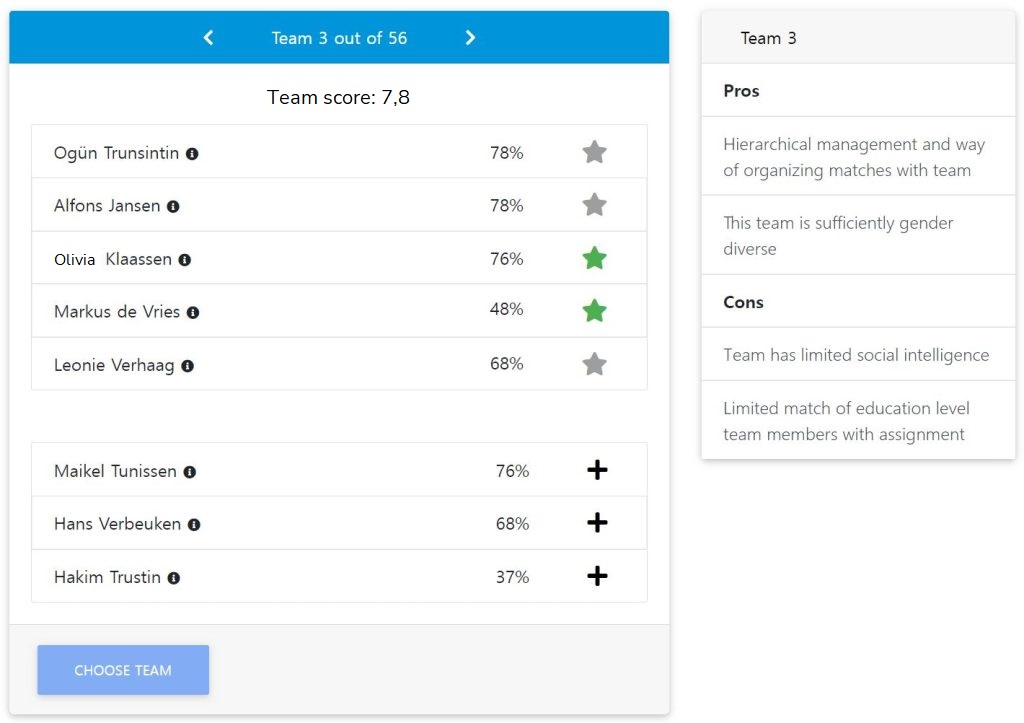
Team-composer helps you create teams where members reinforce one another. Each team is carefully assembled, matching individual strengths and characteristics to create mutual complementarity and robust Collective Intelligence.
Gain insight into project risks
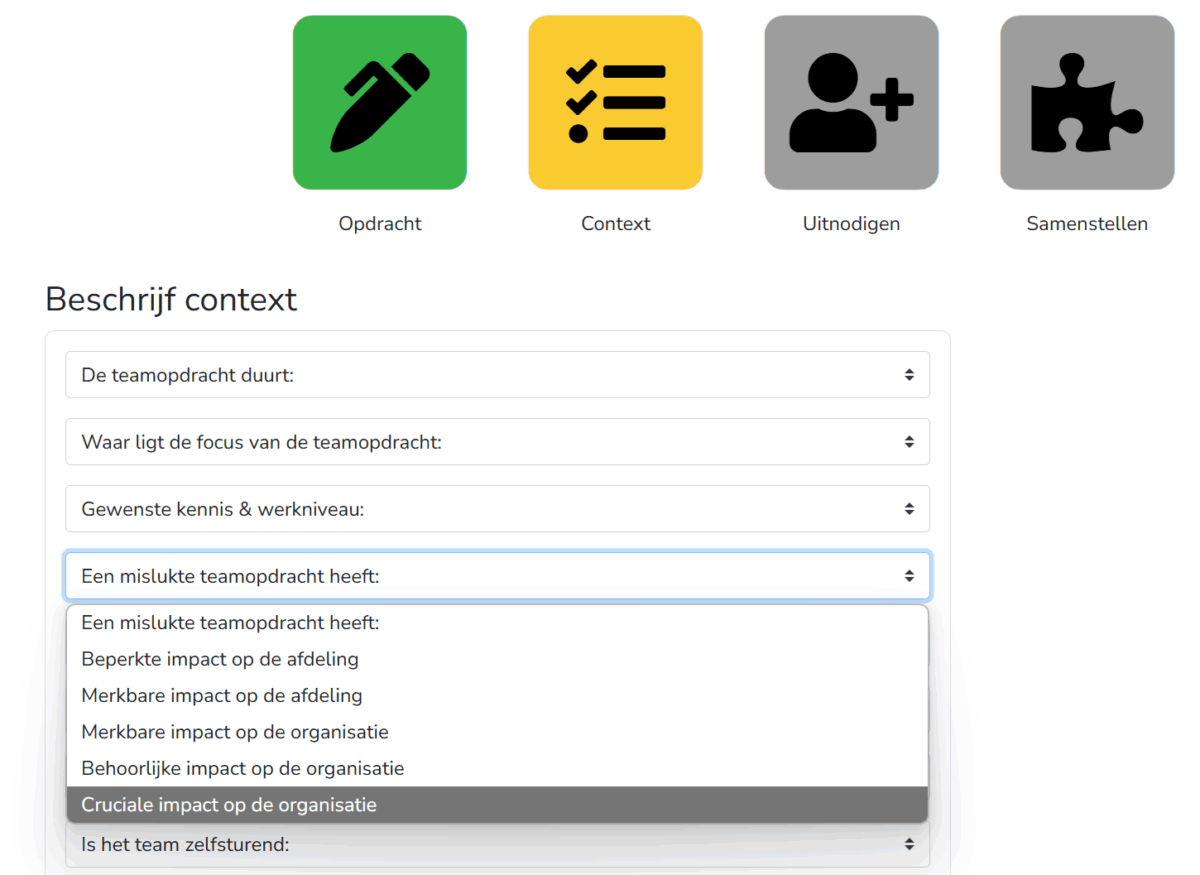
The success of a team and collaboration depends in part on the team assignment. With Team-composer, you can identify the risks of a team assignment in advance. This allows you to make timely changes so that the team can start the assignment under the right conditions.
What makes collective Intelligence so powerful?
Collective Intelligence is a kind of wisdom and knowledge that comes from a group.
Collectively intelligent teams form a kind of intelligence that simply cannot exist at the individual level.
Predict team performance
Many organizations continue to rely on intuition, traditional selection methods, or ad hoc compositions when forming teams. This frequently results in inefficiency, skills mismatches, and diminished team synergy.
Our tool assembles teams by matching combinations of team members to their assignments. Our approach combines predictive psychological insights, AI-driven matching, and data analytics to objectively and transparently assemble teams.
By combining the right professionals, we compose teams that are an optimal fit for the assignment and each other from day one.
Diverse and inclusive
Diversity is not only socially desirable, but it also endures when it contributes to team success. For example, innovativeness depends in part on the degree of diversity in a team. Therefore, we match multiple aspects of diversity to the assignment’s nature.
Inclusiveness is highly desirable and provides functional benefits. Given the scarcity of labor in the market, it is essential for everyone to participate. Our team composition tool enables everyone to contribute to team cohesion and helps avoid human bias in team formation.
With team composer, you make sure everyone can participate and team members can reinforce each other.
Data-driven while maintaining privacy
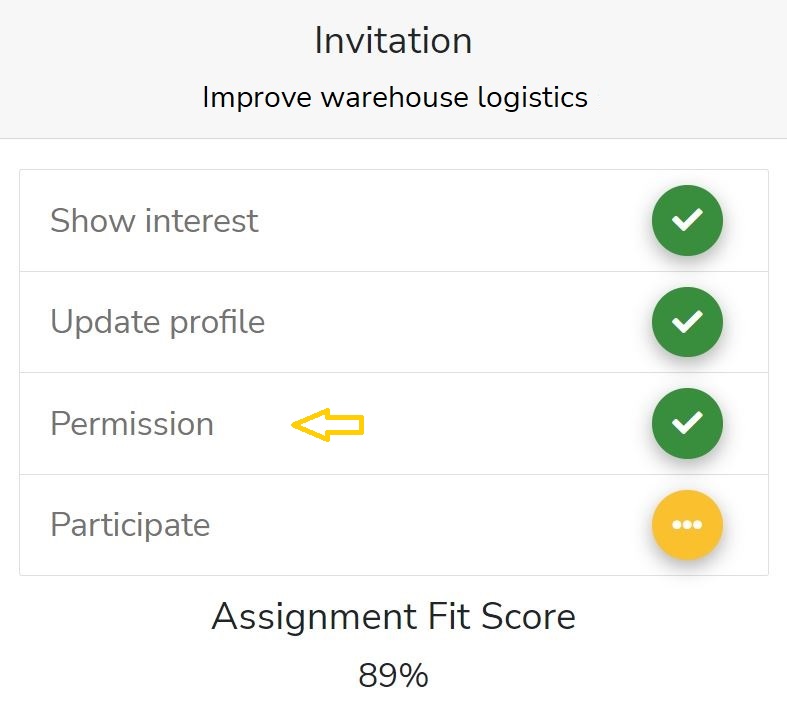
Team member profile includes relevant hard and soft skills. Team-composer assesses soft skills, such as thinking style or motivators. Only a team member can read the results. Once the team member has given informed consent, Team-composer uses the assessment results to compose teams without sharing the assessment data with the team manager. In this way, the assessment results remain the property of the individual at all times.
Multidisciplinary teams as growth accelerators
More and more organizations are moving away from the classic silo-based hierarchy and organizing work into (multidisciplinary) teams. Not because it sounds more “modern,” but because teams and collaboration help you learn faster, collaborate smarter, and innovate more agilely. That’s what growth demands.
Curious to hear stories about teams as growth accelerators? Listen to our Podcasts or join the discussion on LinkedIn group MindsUnited➚.
Scientifically proven concepts
Al bijna een eeuw worden assessments gebruikt om individuele werkprestaties te kunnen voorspellen. Meanwhile, collective intelligence is a scientifically validated concept that can predict team performance and make cooperation within teams smoother.
Collective Intelligence is the shared ability of a group of people to solve problems, make decisions, and deliver superior results together. To achieve Collective Intelligence (C.I.), the team needs specific combinations of psychological traits, depending on the task’s context and objectives.
What is the difference between Collective Intelligence and team chemistry?
Good results require team chemistry. In psychology, we call team chemistry Collective Intelligence.
Team members must complement and reinforce each other to be maximally effective. Team members in collectively intelligent teams reinforce each other’s problem-solving abilities, leading to higher team performance.
what determines collective intelligence?
In general, two factors determine Collective Intelligence: the nature of the task and the combination of the team members. To achieve Collective Intelligence, the team needs specific combinations of psychological traits. These combinations depend on the task’s context and objectives.
Collaborate more effectively, faster, smarter?
Schedule a demo right away
Schedule a consulting session with demo today and discover the world’s first application for forming Collective Intelligent Teams.
This fact sheet provides an overview of the most commonly used (psychological) selection methods, both classical and modern. The figures are based on meta-analyses and dominant scientific literature.